Martin Mawer
I recently came across a term I hadn’t paid much attention to before.
“Nerfed.”
It’s a word people use when something has been weakened.
And the more I thought about it… the more I couldn’t shake the comparison.
Because if there is one place where that word seems to apply almost perfectly today, it is the American church.
Not in how it looks from the outside. But in what it is producing.
For years, we have measured the strength of the church by attendance, by programs, by how full the parking lot is on Sunday morning.
But what if that has been the wrong measure all along?
What if the real question is not how many people are showing up, but what kind of people are being shaped when they leave?
According to George Barna, the director of research at the Cultural Research Center at Arizona Christian University, only 4% of Americans hold a biblical worldview.
Even more concerning, that number is shrinking among regular churchgoers. In just the past few years, the percentage of evangelical churchgoers with a biblical worldview has been cut in half.
So, something is clearly not working. People are still coming. But defenders of truth are not being formed.
And that is where the term kept coming back to me.
Nerfed.
Because what we are seeing is not the disappearance of Christianity.
It is the dilution of it.
We’re seeing sincere believers who are unsure. Present, but unprepared. Engaged emotionally, but not anchored intellectually or spiritually.
They look like Christians. They identify as Christians. But when pressure comes – cultural, moral, or even personal – there is very little beneath the surface.
This didn’t happen overnight. No church set out to create this. But over time, ministry leaders shifted priorities.
Discipleship became optional. Doctrine became uncomfortable. Clarity became risky.
And in its place came something easier to manage.
Messages that inspire, but do not challenge. Environments that welcome, but do not equip. Programs that engage, but do not transform.
Especially for children.
Barna makes a critical point that should stop every parent and pastor in their tracks. A person’s worldview is largely formed before the age of 13.
Before 13.
So what are we doing in those years?
Too often, we fill them with activity rather than a scriptural foundation. Entertainment instead of putting on the full armor of God.
And while that is happening, something else is stepping in to do the job.
Culture does not take a break. The media does not pause. Technology certainly doesn’t stop.
They are consistent. Clear. Repetitive. They define identity, purpose, morality, and truth without apology.
So while the church offers non-offensive fragments, the world offers a complete worldview narrative.
And the next generation is choosing the one that makes sense to them.
Barna said something else that cuts even deeper.
“You can’t give what you don’t have.”
If only a small percentage of parents hold a biblical worldview, then the problem does not start in the church building. It starts in the home.
And when children begin to sense confusion in the people they are supposed to trust most, they look elsewhere.
They always do.
Which brings us back to where we are.
The Nerf Christian is not someone who has rejected the faith.
That would be obvious.
The Nerf Christian is someone who has retained the appearance of faith, but not the substance of it.
Someone who believes, but cannot explain why.
Someone who attends, but cannot apply what they hear.
Someone who feels deeply, but cannot stand firmly.
And when that kind of faith is tested, it does not hold.
It adapts. It bends. It reshapes itself to fit the moment until eventually, there is nothing left to distinguish it from the rest of the world.
And here is the reality we cannot afford to ignore.
A softened church does not remain neutral. It becomes irrelevant.
Because a faith that never challenges, never clarifies, and never confronts will not shape a culture. It will be shaped by it. Every single time.
And this is not the end of the story.
It is a warning. Because what is happening can be reversed.
Not easily. Not quickly. But clearly.
The answer is not more programs or better branding. It is not louder messaging. It is a return to something far more demanding.
Real Christian discipleship.
The kind that forms conviction before the pressure comes, that teaches not just what to believe, but how to think.
The kind that equips people to stand, even when standing comes at a cost.
Because in the end, the future of the church will not be decided by how many people fill the seats.
It will be decided by how many leave those seats unshaken.
And right now, that number is far smaller than we would like to believe.
For years, I have been concerned that too many Christians are being taught how to feel encouraged, but not how to stand firm.
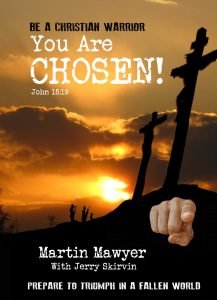
That concern is one reason I wrote You Are Chosen!, a book that challenges believers to stop thinking of Christianity as a passive faith and to understand what it means to become warriors for Christ in an age of hostility, confusion, and persecution.
Because the church does not need more softened believers. It needs men and women who know how to put on the full armor of God, stand in the evil day, and remain faithful when the cost becomes real.
Martin Mawyer is the founder of the Digital Intelligence Project and the President of Christian Action Network. He is the host of the “Shout Out Patriots” podcast, and author of When Evil Stops Hiding. For more action alerts, cultural commentary, and real-world campaigns defending faith, family, and freedom, subscribe to Patriot Majority Report.